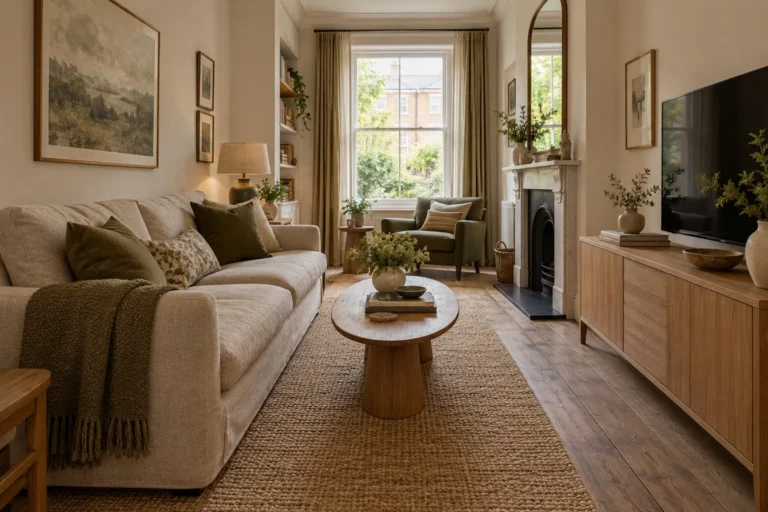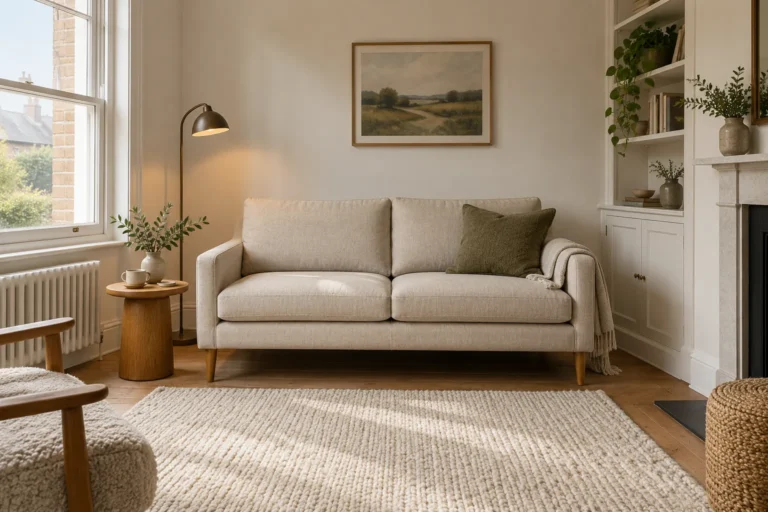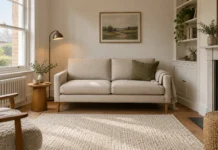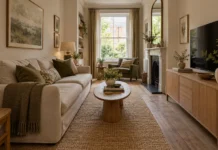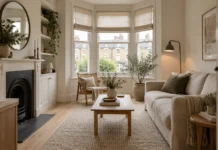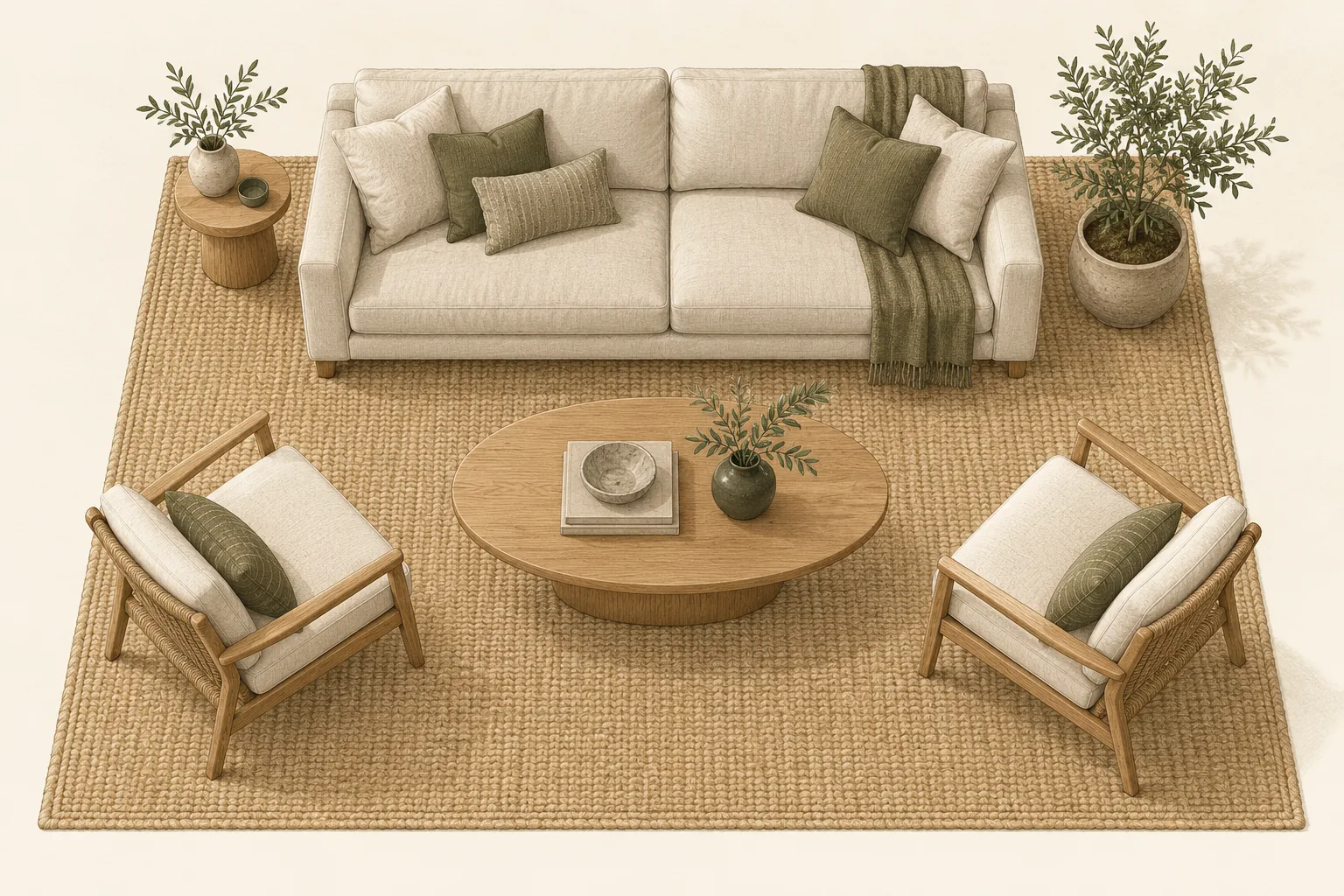
A living-room rug can bring a sofa, chair and table together, or leave them looking like separate islands. The difference is often its position and size rather than its colour.
Choose the furniture arrangement first, then measure the area the rug needs to connect. A label such as large is less useful than the actual dimensions in centimetres. Suppliers offer different size ranges, and the same rug can look generous in one arrangement and awkward in another.
Start with the seating group
Measure the full width of your sofa, including its arms, then note where the front legs sit. Add the position of any armchairs and the coffee table. You are measuring a group of furniture, rather than trying to cover the centre of the room.
In an open-plan space, the sitting area may sit to one side of the overall floor. Centring a rug on the room could leave it disconnected from the sofa. Centre it on the activity instead, while keeping door swings, hearths and walking routes clear.

If the furniture is still undecided, start with measuring a sofa for a small living room and test one of these narrow living room layouts before buying the rug.
Choose a placement before choosing a size
Front legs on the rug
Place the front legs of the sofa and relevant chairs on the rug, leaving their back legs on the floor. This is a useful way to connect a sitting group without covering the whole floor. Allow enough overlap for the legs to sit securely rather than balancing on the edge.
All the seating on the rug
A larger rug can hold the full sofa and chairs. Measure from the back of the deepest item to the furthest chair, rather than using the sofa alone as a guide. This arrangement can work particularly well when a floating seating group needs a clear boundary.
Only the central table on the rug
A smaller rug can sit separately in front of the seating. It should look intentional, with consistent relationships to the sofa and table, rather than like a larger rug that has shrunk. Avoid a layout in which one chair leg repeatedly catches the edge.
Ruggable’s placement guide also distinguishes seating that touches the rug from arrangements in which the rug sits independently. Neither approach replaces measuring the furniture you own.
A worked example with a 210cm sofa
Suppose your sofa is 210cm wide and you are comparing rugs measuring 160 × 230cm, 200 × 300cm and 240 × 340cm. These are illustrative shopping sizes, not a claim that every retailer supplies them.
Place the longer side parallel to the sofa. A 230cm edge extends just 10cm beyond the sofa at each end when centred: (230 − 210) ÷ 2. A 300cm edge extends 45cm at each end, while a 340cm edge extends 65cm.
Now check depth. A 160cm-deep rug may not reach both the sofa’s front legs and a chair opposite. A 240cm-deep rug might connect them beautifully, or extend into a doorway. Width alone cannot settle the choice.
| Rug, short side × long side | Extension beyond each sofa arm when centred | What to test |
|---|---|---|
| 160 × 230cm | 10cm | Whether the rug feels too narrow beside the arms |
| 200 × 300cm | 45cm | Chair positions and surrounding routes |
| 240 × 340cm | 65cm | Door openings and the depth of the complete group |
Mark out the shortlist on the floor
Use paper or suitable low-tack tape to outline two possible sizes. Avoid tape that could damage a delicate floor finish. Place the sofa and chairs as they will actually be used and look from the doorway as well as from above.
Open nearby doors, pull out any storage footstool and check the route to the window. If a door passes over the rug, account for the combined thickness of the rug and its underlay. A door that clears a taped outline may catch a thick pile.
For a chaise sofa, draw the chaise as well as the main seat. Decide whether the rug connects the whole L-shaped footprint or sits within it. Do not automatically align the rug with the centre of the sofa’s back if that makes it feel unrelated to the projecting seat.
Consider the edge, pile and floor beneath
Once the size works, check the practical details. A deep pile can feel inviting but may be less convenient under frequently moved furniture. A flat rug may suit a busy route, but its corners still need to lie securely. Use any underlay recommended for both the rug and your floor, and check compatibility with underfloor heating where relevant.
Look beyond a material’s appearance. Read cleaning instructions, check whether the full rug fits your washing machine if washability matters, and ask for a sample when texture is important. John Lewis’s rug guide explains how materials and construction differ; use the individual product’s specifications for the final decision.
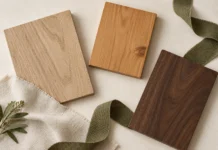
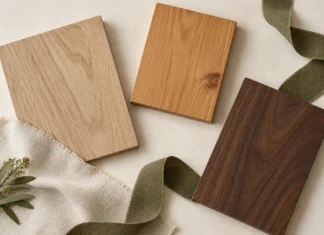
A rug can also soften the transition between different timber finishes; our guide to mixing wood tones shows how to build a coherent palette.
Does a small room always need a small rug?
No. A rug that connects the seating can make a compact room feel more coherent than a much smaller one stranded beneath a coffee table. Equally, a rug that obstructs doors or runs into the hearth is too large for that arrangement.
The useful test is whether the rug supports the furniture and leaves the room easy to use. For the surrounding scheme, explore hygge and Scandinavian interiors. A calm palette is easier to achieve when the proportions already feel right.
Further Reading