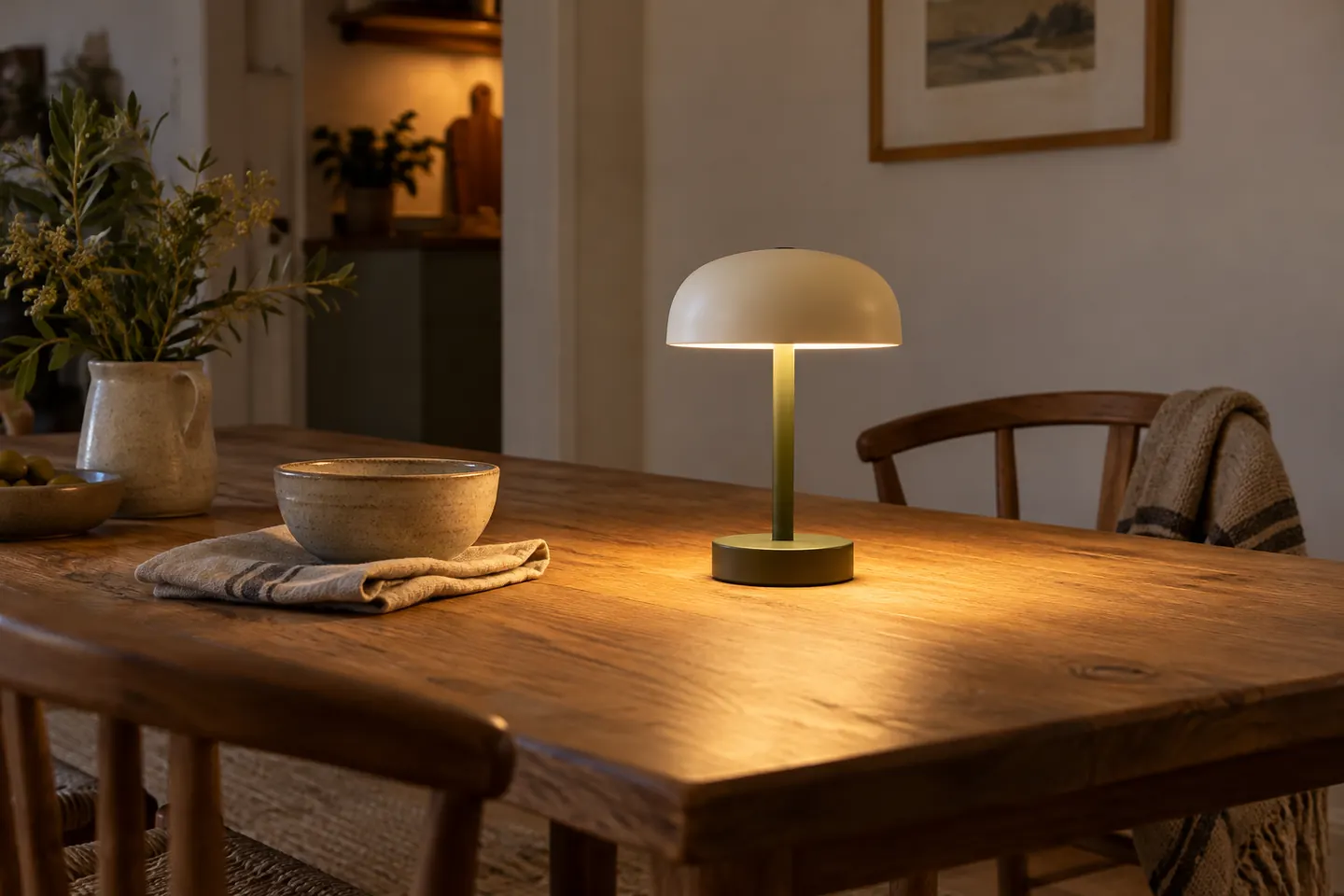
Rechargeable table lamps let you put a pool of light where a trailing cable would be awkward: the middle of a dining table, a shelf away from a socket or a small occasional table. Their appeal is partly practical and partly decorative, especially in a room where the main light feels too strong in the evening.
But a cordless lamp still needs a charging routine, enough useful light and a place where it sits securely. Before choosing a finish, check the job it will do. This is a buying checklist, not a hands-on comparison or a ranking of tested products.
Give the lamp one main job
Write down where you expect to use it most often. “Dining-table atmosphere for a few hours” is a different brief from “reading a paperback every night”. A decorative glow may be exactly right for one and disappointing for the other.
IKEA’s rechargeable lamp range illustrates the category’s appeal as a movable layer alongside fixed lighting. Think of portability as an option, rather than assuming one small lamp can replace every other light in the room.
If you are unsure which layer is missing, our guide to ambient, accent and task lighting is a useful starting point. Choose the role first; then compare the products that can plausibly fulfil it.
Compare runtime at the brightness you will use
A long headline battery life needs context. Check the brightness setting used for the claim, as well as whether the figure is approximate. A lamp may run for much longer at its lowest setting than at full output.
For example, the manufacturer’s Tage rechargeable lamp manual gives different operating times for three brightness settings: approximately 60 hours at 10 per cent, 15 hours at 40 per cent and six hours at full brightness. Those figures describe that specific model, not a promise for rechargeable lamps generally.
For your shortlist, record the setting that suits your use and the stated runtime at that setting. A dim glow that lasts all weekend is not equivalent to a brighter light lasting through a single evening. Neither is automatically better; they answer different needs.
Read brightness and colour separately
Look for the stated light output in lumens and the available settings, then ask to see the lamp illuminated. Colour temperature, usually stated in kelvin, is a separate specification from brightness. Compare both when deciding whether the light will sit comfortably beside your existing lamps.
Product photographs are useful for shape but cannot reproduce the exact experience of light in your room. If reading is the priority, ask specifically whether the lamp is intended for that task. Check the view from a seated position: a visible bright light source may be uncomfortable even when the table looks attractive.
Our guide to smart bulbs and smart plugs covers a different decision: controlling lamps you already own. A rechargeable light is not automatically app-connected or compatible with your home’s smart controls.
Plan where charging will happen
Find out whether charging uses a cable, a dedicated base or a removable battery system. Check what is included and the charger specification required. Do not assume that a familiar-looking connector means every charger is suitable.
The Tage manual, for instance, lists a supplied cable but a separately sold power adapter. Other lamps use different arrangements. Read the exact manual before buying, including instructions about charging conditions and whether the lamp can be used while charging.
Imagine the end of the evening. Will you carry the lamp to a socket, return it to a charging base or leave it on the table? Choose a routine you will actually follow. A clear, accessible charging position is more useful than storing the cable in a drawer at the other end of the house.
Check the footprint and the controls
Measure the base and widest part of the shade against the surface where it will stand. On a dining table, leave room for serving dishes and for people to see one another. On a shallow shelf, check the whole lamp’s depth rather than the base alone.
Try the switch or touch control if possible. Is it easy to find in low light? Does changing brightness require cycling through several settings? Ask whether it remembers the previous setting or restarts at a default. These details can matter more in daily use than another available colour.
Confirm outdoor use and long-term care
Portability does not establish outdoor suitability. Check the model’s stated intended use and weather restrictions, plus separate charging and storage instructions. An indoor lamp should not be treated as a garden light just because it has no cable.
Also ask whether the light source and battery are replaceable, who can replace them and what support is available. For decorative shades and finishes, check cleaning guidance before using sprays or damp cloths. Follow the manufacturer’s charging instructions and stop using a damaged lamp or battery.
The best fit is a lamp with a clear job, enough runtime at a useful setting and a charging arrangement that suits the room. Once those checks are settled, its colour and shape can become the enjoyable part of the choice.