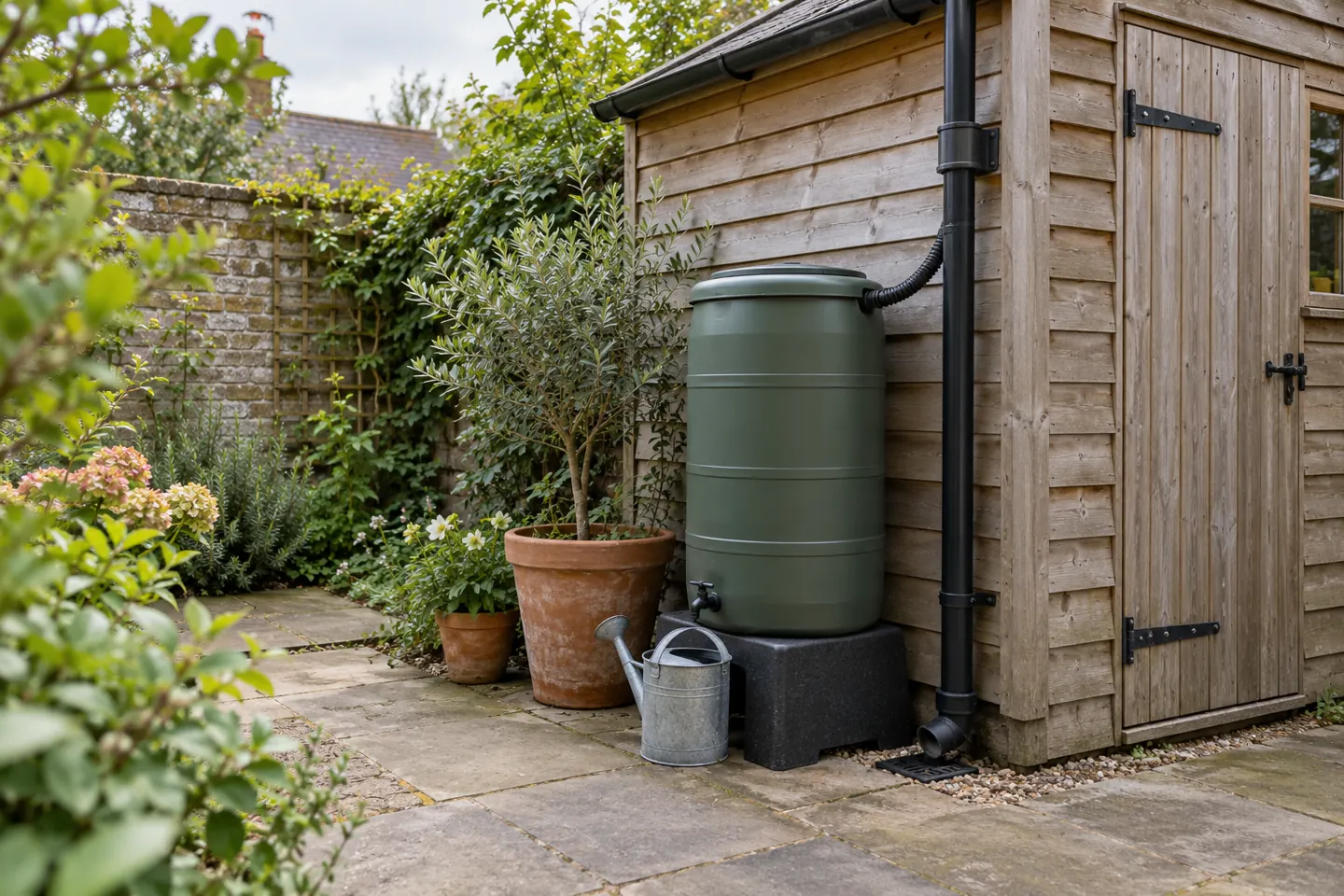
A water butt can earn its place in a small garden, but it needs more thought than finding an empty corner. The best position connects to a suitable rainwater downpipe, leaves room to fill a can and keeps the route to the shed or back door comfortable.
Start with how you use the garden. If most of your watering happens around a few patio containers, an accessible modest tank may be more useful than a larger one hidden behind furniture. Plan the working space as carefully as the container itself.
Find a suitable source of rainwater
The RHS guide to collecting and storing water describes collecting rain from roofs such as a house, shed, garage or greenhouse, using guttering and a downpipe. Slimline designs are available where space is limited. Check the actual position and shape of your downpipe before choosing a tank and diverter.
Photograph the proposed area from the side as well as straight on. Include the ground, the downpipe and anything that opens nearby. A clear photograph makes it easier to ask a supplier whether a particular kit will fit, rather than assuming a product image matches your arrangement.
If you rent, or the guttering and downpipe are shared, establish permission before altering them. Do not connect a water butt to waste pipework. If you cannot identify the pipe or its route, have it checked before planning a connection.
Measure the working footprint
Write down the tank’s width, depth and height, then add its specified stand and installation clearances. A slim profile against a wall does not mean the whole setup takes up no usable space. The tap, connecting hose and lid all need attention.
Set an empty watering can where you would fill it. Can it stand under the tap without being held at an angle? Can you lift a full can away without hitting a fence, pot or chair? Check that the shed door still opens and that nobody has to squeeze around the setup.
Our small patio layout guide explains how to protect circulation space. Add the tank to that same plan, alongside planting and furniture, rather than treating it as an afterthought.
Allow for the weight and the base
Water storage becomes heavy when filled. Severn Trent’s water butt assembly guide highlights that each litre adds about a kilogram and calls for a firm, flat support for its system. Use the base and support arrangement specified for your chosen product.
A wonky stack of spare materials is not a substitute for a suitable installation. Consider the ground beneath the base as well as the top surface. If the proposed position is on decking, a balcony or another raised structure, get its load suitability assessed before adding a filled tank.
Do the practical assessment before trying to disguise the tank. Decorative screening cannot make an unstable support suitable, and it should not prevent inspection or access.
Understand what happens when it is full
Ask how the particular diverter and overflow arrangement operates. A supplier may specify the relationship between the diverter, inlet and tank height; those details are part of the product’s installation instructions. Do not copy the cutting height from a different kit.
Water Butts Direct publishes separate installation guides for different tanks and diverters. Read the matching guide before purchase, especially if the downpipe has an unusual shape or sits close to a corner.
The overflow needs an appropriate route. The purpose of the tank is not to redirect excess water towards the house, a neighbour’s property or a walking surface. If the drainage arrangement is unclear, ask an installer to assess it rather than improvising.
Make it quiet in the garden’s design
Imagine a narrow courtyard with a timber shed at one end. A muted tank beside the shed could sit outside the main seated view, while a short group of pots creates a softer foreground. Keep the tap and lid accessible instead of planting a dense screen around every side.
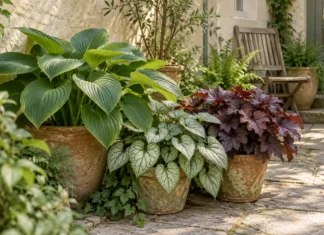
Repeat a colour already present in the garden: olive beside foliage, charcoal beside dark fencing or a restrained terracotta tone near brick. The tank does not need to imitate a planter to feel considered. It simply needs a position that looks intentional.
For a wider rethink, see our guide to making the most of a small garden. Give practical equipment a place in the design from the beginning.
Keep access for routine care
The RHS recommends a close-fitting lid and annual cleaning. Keep the supplied lid properly secured, prevent children accessing stored water and check filters and connections according to the manufacturer’s guidance. Stored rainwater is for garden use, not drinking.
Choose a setup you can reach, inspect and use without moving half the garden. In a compact space, that everyday convenience is what turns a water butt from another object beside the shed into a useful part of the garden.
Further Reading