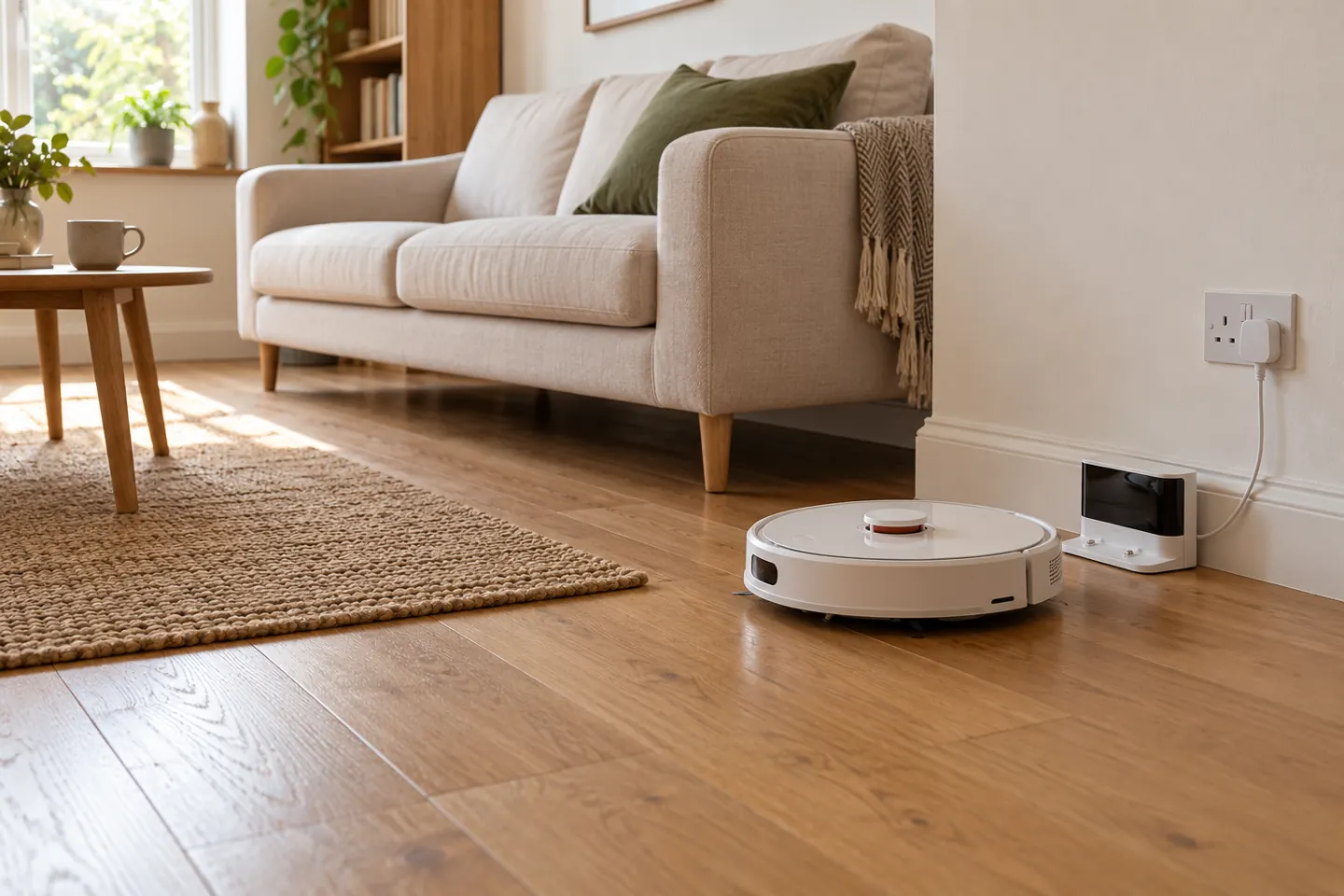
A robot vacuum may be small, but the space it needs extends beyond its round body. There is the charging station, the route back to it, the gaps beneath furniture and the room you need to empty a bin or lift out a tank. In a compact home, those details can matter more than a long feature list.
This is a planning guide, rather than a hands-on product comparison. Use it to record the measurements of your home, then check them against the instructions for the exact model you are considering.
Choose a home for the dock first
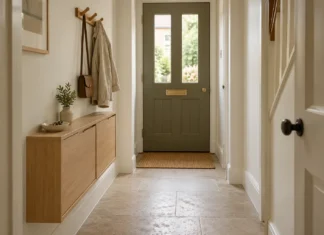
Before browsing suction figures, decide where the robot would live. Look for a position that does not compete with a door swing, chair movement or your main walking route. Mark the dock’s stated width and depth on the floor with a removable template, taking care not to damage the finish.
Add the operating clearance specified in its manual. The machine needs a way to approach the dock; a gap that physically holds the station may still be unsuitable. iRobot’s dock-placement guidance is one example of why you should consult the manufacturer rather than assume every charging base has the same requirements.
Also consider the tasks you will do while it is parked. Can you open the bin compartment, remove the water tanks if fitted, reach the socket and clean around the station? Do not tuck a dock into joinery without checking ventilation, access and the manufacturer’s installation requirements.
Measure the lowest point under furniture
A sofa may look high enough at the front while a crossbar sits lower underneath. Check the entire route the robot would take, including the edge where it enters. Compare that space with the full height stated for the model, including any raised sensor housing.
Width matters too. A robot that fits beneath a bed may not fit between its legs or turn around a storage box. Record the narrowest opening rather than relying on the overall furniture dimensions in an old order confirmation.
If changing the room arrangement is already on your list, our narrow living-room layouts can help you establish a clear route. There is little value in planning around a cleaning machine if the new arrangement makes everyday movement less comfortable.
Make a map of floor changes and rugs
Sketch the rooms you expect the robot to clean. Mark door bars, changes in floor level, loose rugs, mat edges and any steps. Measure these individually and compare them with the model’s documented capabilities; a headline threshold claim may depend on the shape and arrangement of the obstacle.
Photograph awkward transitions so you can ask the manufacturer a precise question. “Will it work in my flat?” is difficult to answer. A photograph, the measured height and a note about the adjoining floor surfaces give support staff something concrete to assess.
Check rugs separately from fitted carpet. Roborock’s guidance on shag carpets explains that long pile can trigger cliff sensors on affected robots. This is a model-compatibility question, not a reason to disable safety sensors. Ask about your actual rug type, including fringe, before buying.
Our living-room rug measuring guide addresses furniture placement. Keep that design decision separate from the robot’s ability to cross and clean the rug.
Decide whether mopping suits your floors
A vacuum-and-mop combination introduces another set of decisions. Check whether your floor manufacturer permits the proposed cleaning method, how the robot treats carpet and what its manual says about liquids and cleaning products. Do not infer suitability from a photograph of a similar-looking floor.
Ask how the particular model handles the boundary between hard flooring and rugs. Some products have settings for carpet recognition or mop lifting, but capabilities and limitations differ. Read the instructions for your chosen version rather than transferring a claim from another model in the range.
Allow for the small jobs around cleaning
Consider what normally lives on your floor: charging cables, shoes, pet bowls, toys or the ends of curtains. Work out what you would need to move before a clean. A regular five-minute reset may be acceptable; reorganising half the room each time may undermine the convenience you wanted.
Maintenance also needs a place in the routine. Roborock’s maintenance guide discusses the bin, sensors, wheels and brushes. Follow your own machine’s manual for methods and intervals, including whether a filter can be washed. Self-emptying does not mean every part takes care of itself.
Take a short checklist shopping
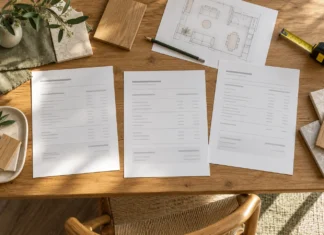
Write down the dock position and clearances, lowest furniture opening, narrowest access gap, floor transitions, rug details and floor-care restrictions. Add your Wi-Fi and app requirements, and check which functions depend on them.
That page gives you a useful shortlist: machines that can live and work in your rooms. Choose between those on the features you will actually use, rather than making an unsuitable space fit the most impressive specification.